Thursday, 2 April 2009

Health and safety reps beat bosses' no chairs rule

The unpopular OTP ('Operational Transformation Project') working pattern imposed clunkily by NHSBT management on blood collection teams a few years ago has many flaws according to donor carer staff. One which caused great health concern, with a increasing rise in occupational health referrals, was the attempted removal of chairs for staff from donor sessions.



Union health and safety reps from across the staffside worked together and fought hard against this ruling, using the law as a weapon. A great coup was achieved by getting in the Health & Safety Executive (HSE) to carry out an inspection. The HSE is an under-funded body that rarely visits workplaces.

The HSE report released in March this year fully backed up what health and safety reps had been arguing. Following this blow to their authority management had no choice, in the light of hard evidence, but to accept the findings of the HSE's report and replace chairs. This is a fantastic victory achieved by union reps that will benefit collection teams everywhere.

Health and safety law can be a valuable tool for workers. Over the years union activists have pushed to make it rule in our favour. The fight to improve working conditions goes on constantly. At the extreme end unsafe working can kill and make people seriously ill. Each year more people die through their work than from war.

The ILO (UN International Labour Organisation) estimates that 337 million accidents occur on the job annually, while the number of people suffering from work-related diseases is close to 2 million. These mistakes amount to approximately 2.3 million deaths each year, with 650,000 of them due to hazardous substances – double the number of a few years ago.

Don't forget Workers Memorial Day, 28th April every year across the world. It is a day to remember those who have been killed by work, but also to fight for better health and safety in the present, as reps in NHSBT have been doing.

Labels: , , , ,

Friday, 13 March 2009

IWW Blood Service Valentine's Day of Action

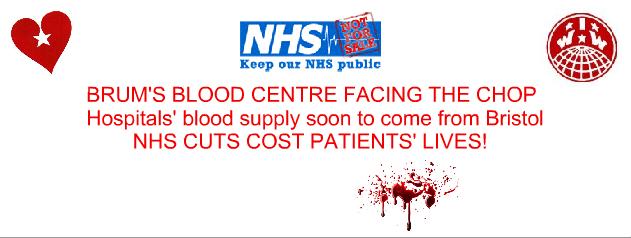
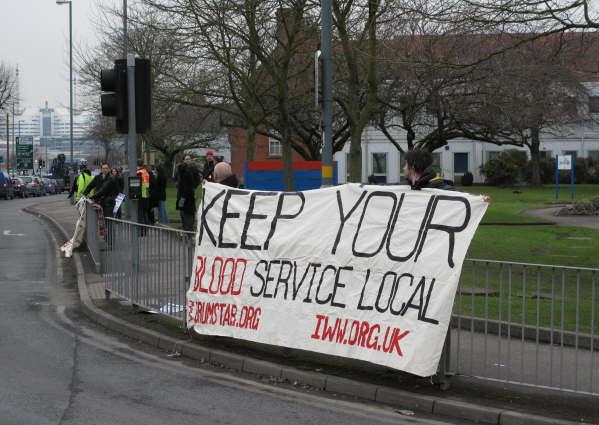
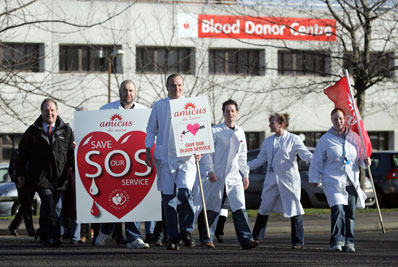
On Saturday 14th February 2009 West Midlands IWW held a cavalcade to raise awareness of cuts taking place at the Birmingham blood centre this March.

The IWW is a union with members working in the National Blood Service. They will be affected when the local blood processing lab shuts and transfers its work to a new centralised ‘super-centre’ in Bristol. Staff believe this is a risky plan which could delay urgent specialist blood products from reaching patients in West Midlands hospitals. Around 70 jobs will go with the closure.

The mobile demonstration, including a van with banners, cyclists and cars, set off from close by the soon-to-be-slashed blood centre and passed the Queen Elizabeth hospital and medical school, before making stops at Selly Oak, City and the Children’s hospitals. Road users were made aware of the cuts as the cavalcade travelled around Birmingham’s main arteries. Around 30 protestors wound up the day leafleting the public in New Street outside the donor centre. The blood service depends on the generous donations of the public - many more will need to receive a blood transfusion at some point in their life.

Click on pictures to see bigger version


The campaign has not managed to save Birmingham’s blood processing lab, but on the positive side, opposition to the plans from workers and their supporters has meant that Birmingham will keep its vital red cell crossmatching lab, and in the North and South-East, blood processing centralisation plans were halted completely.

Labels: , , , ,

Sunday, 8 March 2009

Greetings on International Women's Day

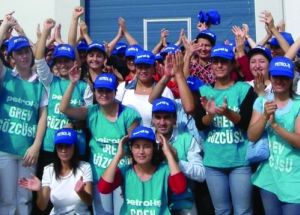
To celebrate International Women's Day today this blog is posting a story that began in September 2006. 84 workers, 82 of them women, making medical equipment in Turkey went on strike for over a year, fighting against gross abuses by their employer Novamed.

Following is a list of some of the abuses as alleged by the woman workers of the union:

* Married woman workers are not allowed to become pregnant without FMC Novamed's approval. Each worker is given a schedule, which specifies during which months they are allowed to become pregnant. If a woman worker becomes pregnant in "breach" of this given schedule, she is terminated without compensation.
* Woman workers are required to get permission from the employer before getting married.
* To "save energy" for their work at the factory, workers are being advised:
- not to accept guests in their own homes when they are off the clock,
- not to communicate or even have sex with their spouses when they are off the clock,
- not to see each other when they are off the clock,
- only to eat and sleep when they are off the clock.
* Workers are treated inhumanely, and continuously humiliated regardless of whether they make a mistake or not.
* Managers and supervisors call their workers to their office and accuse and humiliate them in such a way that there are few workers who come out of these accusation-performances without crying.
* Workers are not allowed to talk to each other during work hours, as well as in the shuttle during their trips from and to work.
* Workers are allowed inside the factory premises after being "sniffed" by their supervisors, because smoking during work hours is forbidden.
* During work hours, there is only a 15-minute break and a 25-minute lunch break. During lunch, instead of food, the factory is serving tea and cookies.
* An average shuttle trip from home to work may take as long as 2 hours because there are not enough shuttles allocated by the factory for the workers.

Read more here.


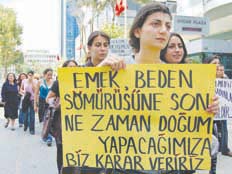
Picket sign states: "We decide when we give birth"


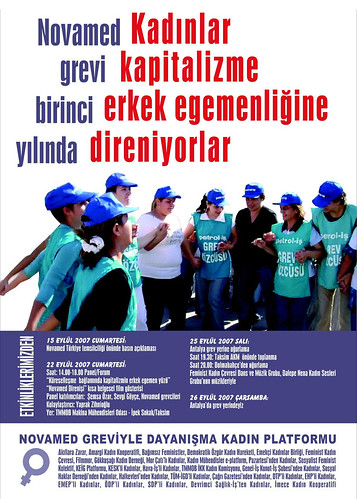
Novamed women's union poster

At the outset of the battle there was no union at their factory but they got organised with the help of the union Petrol-Is. After 447 hard days striking, up against anti-union tactics by management, but with wide international solidarity, the workers won.

From December 18th 2007:
A three-year initial labour agreement was signed today in Istanbul between Petrol-Is and Novamed that ends a historic strike by 84 of the workers in Mersin, Antalya. The strike, which will stand as a test of courage for fairness and dignity on the job, began on 26 September 2006.

The settlement will bring the 84 strikers, 82 of whom are women, back to the job, and will grant all workers a wage increase of 5% for the first year, and of 4% for the second and third year of the agreement. It also brings a social package that includes a payment for each of two religious holidays in Turkey, as well as productivity and attendance bonuses for workers. All the striking workers will return to work on the 2nd of January 2008.


The agreement was historic as it marked the first trade union inside Antalya, Turkey's 'Free Trade Zone' (an area where sweatshops can operate).

Read about their victory in full.


Novamed is owned by Fresenius Medical Care of Germany. This firm manufactures one of the types of blood bags used by the National Blood Service in this country. Workers in the NBS have a direct connection to these brave and inspiring people.

Fresenius has also been investigated over bribery allegations.

"According to a 2005 UN report, Fresenius Medical Care was one of more than 2,000 firms around the world alleged to have made illicit payments to Saddam Hussein's government to profit from the aid programme."

Read more here.

Labels: , ,

Tuesday, 5 February 2008

Outcome of the Blood Service strategic review

The review of the NBS restructuring strategy is now complete and these are the outcomes.

The outcry from hospitals, staff and the public at the dangerous and stupid proposals has meant that in the north and south-east, the board have been forced to scrap the idea of supercentres. One excellent victory that we can claim is that the Newcastle centre is now to remain fully open, and Sheffield also keeps many more functions.

northern nbs staff

But the axe still hangs over essential labs at centres across the country.

From the north and south-east of England, processing labs are still earmarked for closure at Leeds and Tooting, and testing labs are planned to be shut at Brentwood, Leeds and Tooting.

NBS RCI reference labs, which crossmatch blood for patients with rare or reactive blood types, are critical to have closely linked with hospitals in the area. Despite this, NBS directors still think that they can get away with closing RCI labs in Manchester, Southampton, Cambridge, to cut costs.

The NBS has also taken advice that it should consider ending its role in antenatal screening by 2011. This will cost more jobs, and will eventually cost the wider NHS as well. The NBS is able to do this testing at a fraction of what it costs hospitals to do it themselves. If they in fact extended their involvement in antenatal screening, they could create more income for NHS Blood and Transplant, as well as lightening the load on hospital budgets. It seems the word foresight is missing from the NBS management dictionary.

Interestingly the revised proposed strategy will cost a predicted 600 jobs, in addition to those slashed in the midlands and south-west consolidation. Before the review the figure of 600 applied to job losses in total across the whole country. It should also be noted that bosses want to cut more jobs in the extremely understaffed collection teams - at a time when collected donations are way below target.

Meanwhile in the midlands and south-west zone, directors are desperately clinging to the supercentre model, reluctant to face the humiliation of abandoning their flagship Filton supercentre venture. This was purposely left out of the review as bosses knew McKinsey & Co. would advise against such a drastic cut, as has been proven in the other two regions. Large processing labs from Birmingham, Southampton and Plymouth are still destined to be packed off to this white elephant. Directors also want to inexplicably uproot donor typing and patient screening from Colindale, and the national Cord Blood Bank from Edgware, to Filton in Bristol. The only apparent reason for this is an attempt to further justify that the shiny hangar is not going to be a terrible waste of resources.

Now that the factual support is crumbling, we have to push on campaigning against centralisation. No decision on the fate of our health services should ever be made based on keeping someone’s CV unsoiled.

Thanks to all campaign supporters for your valuable help so far - we’re getting there, and reason is on our side - let’s keep on fighting!

Labels: , , ,

Friday, 14 December 2007

Liverpool city council condemns cuts programme

Liverpool City Council has just adopted the following resolution over the closure of the Liverpool Blood Centre:-

"That this Council deplores the proposal to drastically reduce the
number of regional blood centres from 12 to 3 so called super centres
to serve the entire country. Council also deplores the inadequate
"consultation" which has taken place over this ill advised and
damaging proposal. Council condemns the potential significant loss of
skilled jobs and reduction in workforce size which will result if this
proceeds unchanged. Council also notes that this will severely stretch
the current close working relationships between the regional centres
and local hospitals.

Council recalls that the previous rationalisation of the National
Blood Service by the Tory Government in the 1990s was opposed by all
members on the City Council and calls for all party support against
this risky and unproven Labour Government proposal which is driven
purely by the desire to cut costs, possibly as a prelude to potential
privatisation of this profitable service. Council also requests all
Merseyside MPs to strenuously oppose this stupid plan."

[The agenda for the Liverpool City Council meeting is online here]

Labels: ,

Monday, 27 August 2007

Sheffield council supports our campaign!

We are delighted to announce that following a debate held between NBS workers and management, Sheffield City Council (Health and Community Care Scrutiny and Policy Development Board) considered their position on the centralisation plans, and have come out publicly, strongly and thoroughly condemning the strategy.

The recent terrible flooding in England almost crippled Sheffield blood centre and it is testimony to the great skill and teamwork of NBS staff there and at connected sites that a reliable supply of blood products was able to be safely maintained to hospitals without too many difficulties. This is proof of the benefits of the Blood Service operating from many local depots and not piling all its eggs into 3 baskets with vulnerable supercentres.

It doesn't take much to persuade people of why we think the proposals are wrong, but well done to the supporters and reps at Trent NBS involved for winning us this valuable victory!

Read the full minutes of the debate on 11th June here

Here is the Council resolution, passed on 25th June 2007.

From Sheffield City Council
NATIONAL BLOOD SERVICE
The Board gave further consideration to its response to the presentation made by the National Blood Service upon the National Health Service Blood and Transplant Service Strategy 2006-10, considered by the Board at its meeting held on 11th June, 2007.
RESOLVED:
That in the light of the information made available, this Board
(a) views with grave concern the proposals outlined by the National Blood Service to re-organise the Service in England and Wales without sufficient evidence of the need to re-organise the Service and particularly with regard to the impact of the re-organisation proposals in the City,
(b) believes that these proposals could result in Manchester being the nearest Testing and Processing Site to the City and serving the whole of the North of England and Wales and the transfer of blood storage and distribution facilities in the City to Leeds, thereby putting at risk the availability of blood and blood products in the City, particularly in emergency situations;
(c) views with disquiet the lack of clarity as to whether or not the Strategy was formulated in consultation with medical experts and laboratory managers from local hospitals and if the strategy has the support of these professionals;
(d) notes with concern the fears expressed by the trades union and others that the proposals would have a severe impact upon the ability of the Children's Hospital to continue its internationally renowned work on children's leukaemia, the training arrangements for Consultant Haematologists in the City, the immediate availability of specialist blood components and the carrying out of specialist research and development activities such as stem cell research, which are presently supplied by the Sheffield Centre;
(e) does not accept the premise put forward by the National Blood Service that the NBS Centre in Sheffield was "not fit for purpose" when the Centre has recently under gone several major refurbishment projects and, in the opinion of managers, is now fit for purpose for at least another 10 years;
(f) would wish to express its dissatisfaction at the apparent lack of accurate costings for the proposals including transportation costs thereby not giving the Board any opportunity to reach "judgment" on the economic veracity of the proposals; (g) is of the view that the underlying philosophy behind the proposals is driven by economic consideration rather than service improvements particularly as no information regarding costings and deployment was made available to the Board;
(h) is concerned that this matter was brought to the attention of the Board in the first instance by the trades unions representing employees of the NBS in the City and not by the NBS and would urge the Secretary of State for Health to remind the Health bodies of their responsibility to engage in meaningful and comprehensive consultations with Local Authorities and other parties regarding proposals for service change and also to request in the strongest possible terms to examine closely the processes for disseminating information and engaging in consultation so as to ensure that substantial systemic improvements are made to prevent this situation arising again;
(i) believes that at a time when all agencies are committed to taking positive steps to reduce the environmental impact of road travel there would be every possibility of an adverse environmental impact through increased transportation of blood
products to the City together with the concomitant dangers of inaccessibility to the City in adverse weather conditions;
(j) whilst recognising that it is not within its remit to become involved with or comment upon the possible adverse economic impact of the proposals upon the City's regeneration would nevertheless urge the Leader of the City Council, the Cabinet Member with responsibility for Economic Regeneration, Culture and Planning and the Chief Executive to pursue this aspect of the proposals with the utmost vigour;
(k) requests that further proposals about this re-organisation be reported to the Board as a matter of urgency; and
(l) requests that copies of this resolution be forwarded to the Sheffield Members of Parliament, the Secretary of State for Health, the Core Cities and the other South Yorkshire Authorities.

Labels: , ,

Thursday, 12 July 2007

Management announce review of strategy!

Following the Board meeting on July 5th, which NBS union reps lobbied once again, Chairman Bill Fullager released this letter to staff on July 10th.

Letter to staff

Dear colleagues,

As you know, NHSBT has made considerable progress in a number of areas since the NHSBT strategy was launched last November. The construction of Filton (on time and on budget), the increase in appointments for blood donors and the record numbers of organs available for transplantation are all tangible examples of this progress.

Given the importance of the service strategy to both patients and the NHS, and in the light of our discussions, with customers and colleagues over the past six months, the NHSBT Board has decided to hold a review of the assumptions underpinning the strategy and its planned changes. This review will be led by Clive Ronaldson, in his new role as interim managing director of the NBS.

The Board remains committed to the vision and set out in the service strategy announced last November. At the same time, we have acknowledged and listened to concerns expressed and issues raised by staff and customers about aspects of these plans. In instigating this review, the Board is seeking to ensure that proposed changes will deliver the greatest benefits to patients. Where the review demonstrates that changes to the strategy are warranted, these will be made.

This means that although some changes in the early phases of the NHSBT change programme will continue as planned, fundamental developments - such as changes to aspects of the current configuration of processing and testing facilities - will not begin until the review is complete.

You will, clearly, have questions about the review and its implications for you and your site. This decision has only just been made and we wanted to make you aware of developments as soon as possible. We are currently confirming the terms of the review and how it will work, in discussion with staff representatives, and will be in a position to give you further details, for example on the timescale, over the coming weeks.

In the meantime, we welcome your views. If you have any immediate queries, please talk to your line manager or send them to us via Connect.

With best wishes,

Bill Fullagar
Chairman
10 July 2007


This is a massive breakthrough for the campaign! Until now the directors have flatly refused to consider any change to their proposals, no matter who from or how sensible. They have felt untouchable. For them to now put the brakes on and admit they are ready to think again about even small parts of the plans means the opposition is reaching a level that they cannot ignore. It can be no coincidence that this letter comes just after staff-side beginning steps for a ballot on industrial action. Bosses have seriously underestimated the staff's willingness to be pushed around and see the Blood Service they are proud of fall into a messy decline in the name of 'savings'.

With this knowledge to spur us on now is the time to carry on campaigning at full speed. Service users and patients still need a bigger say in the running of the NBS. This review shows that we can make sure that the policy-makers have no choice but to involve us all.

It's far from over! The future is still unwritten.

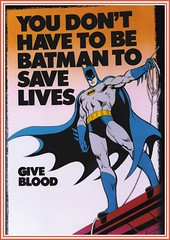
batman

Labels: ,