Thursday, 2 April 2009

Union official's last minute hot air

Last week (26/03/09) the Evening Mail ran this story covering the closure of Birmingham's blood processing, quality monitoring and NAT labs. Tomorrow will be their final day.

Please click for a larger readable version.


Read the story online here.

It is based on a press release from full time Unite officials. This blog has objections from the very first sentence which says: 'Union leaders are trying to halt controversial plans...'.

There can be no doubt that throughout this entire campaign 100% of the energy, sweat, tears and sleepless nights have been spent by unpaid union stewards, active members and their workmates. In fact there are quite a few well-remembered instances of union leaders and officials discouraging and obstructing NBS workers' campaigning efforts.

That is not to say that these officials have not been part of active struggles earlier in their lives, but in the case of the fight against NBS restructuring it is not true to say that they were part of it other than to make vague grand rhetorical statements for press releases.

Now this blog steps down from its soapbox to accept that the choice of wording in the first sentence was made by the journo. The real issue is - what good are statements like these after it is too late to save the Brum blood centre? More of a fight was needed a long time ago. As mentioned above, this was not made easy for us.

Labels: , , ,

Tuesday, 14 October 2008

'Midwifery Matters' Autumn '08 - article on NBS restructuring

This is an article by Morag Forbes published in the Autumn '08 issue of 'Midwifery Matters'.

Restructuring of Britain’s National Blood Services:
Why we should care, and what we can do!


Author’s note: At first sight, this article may seem “off topic” for Midwifery Matters. I decided to write it after hearing from friends working in the blood service. While their job is different to ours, many of the same themes are emerging – cuts, increasing centralisation, and devaluing of staff. And, as you will see, cuts in the blood service will directly affect the care we offer to women.


What is the NBS? What does it do?

England’s National Blood Service (NBS) is over 60 years old. This specialised service collects, tests and processes blood products. Its local nature is essential – local labs understand the needs of local health services.

What are the restructuring plans?

NBS management plan to close local labs across England, replacing them with “supercentres”. Around 600 jobs (roughly half the NBS workforce) would be lost in the process. NBS staff have not been consulted on their opinions of what would constitute a safe and efficient service structure.

Has there been opposition to the plans?


The plans are widely opposed by unions, city councils, NBS staff, and service users. This prompted a review of the plans. In North and Southeast England, the “supercentre” idea has been abandoned. Some local centres have been saved, or have retained functions that were to be cut.

However, many NBS centres are still threatened. Processing and/or testing labs are to be closed at Leeds, Tooting, Brentwood, Birmingham, Southampton and Plymouth. RCI Reference Labs, which crossmatch blood for rare/reactive blood types, will close in Manchester, Southampton and Cambridge. Many services will be moved to a “supercentre” at Bristol.

These plans still mean at least 600 redundancies in the service.

What about the rest of the UK?

The supercentre plan, discredited, but still rumbling on in the South West has now made its way to Scotland too, with plans to close Glasgow and Edinburgh blood centres in the Scottish National Blood Transfusion Service. One ‘super’ facility for the whole of the central belt, would take blood processing away from local communities.

How will this affect healthcare?


NBS staff have severe concerns about the plans’ implications for safe healthcare.

As services become more centralised, blood products must be transported for hundreds of miles, on a potentially unreliable motorway network. Rare blood products may not be available quickly in emergency situations. Longer transport times will mean blood products spend longer in suboptimal storage conditions.

Redundancies in the blood donation service may prove critical, with donation levels already seriously low.

How will this affect maternity care?

All midwives know the importance of speedy access to blood products in emergencies: it may literally be the difference between life and death for a mother or her newborn.

This is especially true for ill babies. Split platelets for newborns are always made to demand, to avoid wastage, and very often wanted in a short time scale. For example, Birmingham Women’s Hospital currently obtains split platelets from a lab within walking distance. Split platelets can be made from adult platelets to be available immediately. If services are centralised to Bristol, Birmingham will have to stock ready-split platelets. These will go in the bin if not used within 4 days (extra travelling time means they lose a day of their 5-day shelf life!). Otherwise, staff will have to phone an order to Bristol, and wait for the appropriate platelets to be sourced, processed and sent along the motorway. It’s easy to see how disastrous this could be.

On a less dramatic level, the next phase of cuts will see the NBS decrease its role in antenatal screening from 2011. This makes no economic sense, when the NBS can perform screening tests at a much lower cost than individual hospitals can. As radical midwives, we may question the routine use of screening. However, for families who choose these services, they should surely be available locally and at minimum cost to the NHS.

What can I do?

- Keep up to date at http://nbs-sos.blogspot.com
- Spread the word to local/national media, other healthcare professionals and service users.
- Ask your city council to pass a resolution opposing the plans. This has already happened in many areas.
- Raise the issue via your local Public and Patient Involvement Forum

'Midwifery Matters' is the magazine of ARM (The Association of Radical Midwives). The magazine is only available to members, but can also be found in some university libraries. Visit ARM's website here, and read more articles from previous issues of MM here.

Labels: ,

Sunday, 12 October 2008

Article on restructuring of US transfusion service

NY Times article about reorganisation of the Red Cross blood tranfusion service in North America. Apparently regulators have found that the transfusion service in the USA has numerous problems - one of the causes being that they are too big, and costs of re-organisation are running far in excess of what was predicted...

Labels: , ,

Wednesday, 24 September 2008

'No-show Gisela Stuart urged to quit hospital committee'

A recent Birmingham Mail story revealed that Gisela Stuart, Labour MP for Edgbaston (location of Birmingham's blood centre), and also stakeholder governor of Birmingham University Hospital Trust, failed to turn up to any of the Trust governor meetings that were held in the last 12 months.

Gisela Stuart, where are you?

NBS workers at the Birmingham centre were extremely unsurprised to hear about this. Some members of staff contacted her immediately when the job losses in her constituency were announced in late 2006. Yet rather than properly interrogating the NBS reconfiguration plans as other, more responsible, MPs and councillors chose to do, she was heard on live local radio saying that in an emergency blood would 'just be rushed up in a helicopter'. Staff were amused and intrigued at this mention of the mystery helicopter which hadn't appeared in any strategy budgets, or in fact anywhere outside of Gisela Stuart's head...

So from the outset Gisela Stuart MP seemed to have aligned herself in favour of the closure of a major health facility and workplace in her constituency.

Later, after the reprieve of Birmingham's red cell crossmatching lab was announced, a story appeared in the local paper unhelpfully trumpeting that Gisela Stuart had been heavily involved in securing this victory. This was false on two counts - not only had she played next to no role whatsoever in events, but the 'victory' was a small one and the area was still set to suffer greatly from the proposed closure of the blood processing department.

Many letters have turned up in the local press expressing worry about the Birmingham blood centre being decimated, at the same time as a gigantic new multimillion-pound superhospital is being build right next door, looming over it in fact. Surely a hospital this massive and shiny (set to replace the current University Hospital) needs to have a fully functioning, top class, blood centre on its doorstep - not just a big chiller?

Well, now we know the reason that Gisela Stuart doesn't seem to be concerned about this situation. Because she is not concerned with Birmingham University Hospital at all. Here we see yet another case of an MP pointlessly holding a seat, like some kind of badge of honour, on a decision-making body that they don't care anough about to take part in. That place would be better off given to a long term patient or service user who depends on the hospital for their wellbeing.

Labels: , ,

Monday, 18 August 2008

Yorkshire Evening Post - 'Fears over plans to move Leeds blood centre'

Published: 25th July 2008
By Katie Baldwin
Health Reporter

Councillors have raised concerns about plans to move services from a blood processing centre in Leeds. The NHS Blood and Transplant Service (NHSBT) wants to scale down the Seacroft centre in Leeds, a move which would affect up to 70 staff.

That could mean blood processing and testing no longer took place in the city.

Leeds City Council's Health Scrutiny Board has now heard evidence from staff at the centre, NHSBT representatives and Leeds Primary Care Trust (PCT).

Board members were annoyed that councillors and Leeds PCT had not been consulted sooner and raised concerns about the impact on Leeds patients.

Scrutiny board chairman Coun Pauleen Grahame (Lab, Cross Gates and Whinmoor) said: "It is vitally important that any changes are properly thought through – after all, lives could be at stake.

"Not only that, but I am very worried about the implications of this closure for the Leeds economy and for the future of Seacroft Hospital.

"The blood treatment centre is a major employer of skilled staff, and it would be a great shame for the city if they were forced to move elsewhere to find work."


You can read the full story and add your comments (please do!) HERE.

Labels: , , ,

Saturday, 5 April 2008

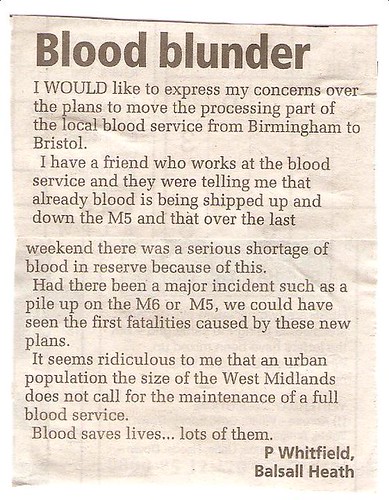
More blood on the letters page


(Birmingham Mail, April 3rd 2008)

Keep on writing to your local papers about the NBS cuts, and keep sending the clippings into this blog at this address:

nbs.sos[AT]gmail.com
(replace [AT] with @)

Labels:

Wednesday, 7 November 2007

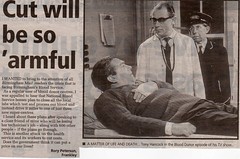
Another press cutting


(Birmingham Mail, October 31st 2007)

Click on image of clipping for bigger view

Labels:

Wednesday, 3 October 2007

More press coverage

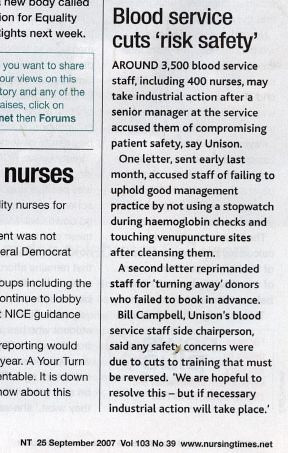
Nursing Times (25/09/07) ran a story on the turmoil in Donor Services following director Richard Fry's bullying of NBS staff.

nursingtimes

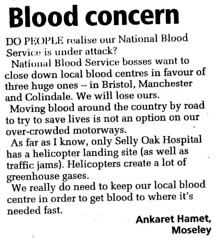
And a concerned member of the public helps to spread the word about NBS lab cuts via the local newspaper letters page.

letter2
(Birmingham Mail, September 27th 2007)

Labels:

Thursday, 5 July 2007

Press coverage

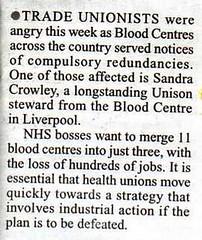
First up is a mention of the first redundancies to hit the NBS due to the centralisation strategy, on Friday 22nd June:

swnbsrep001
(Socialist Worker, 30th June 2007)

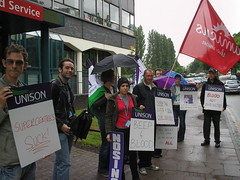
Solidarity
Sandra will be sadly missed in the Blood Service

Birmingham staff marked the leaving of these colleagues with a public vigil to demonstrate that any and every job loss in the service will be remembered and felt.
Solidarity vigil

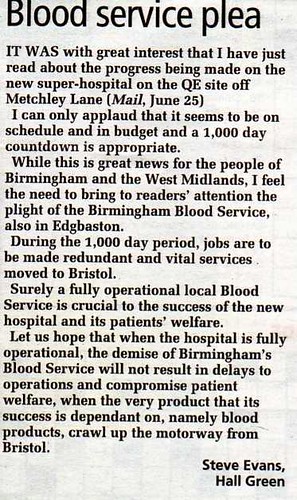
A topical letter to the Birmingham Mail, responding to a report on the progress of the new 'super' hospital in Edgbaston. This massive complex could have a fully functioning blood centre right on its doorstep, but, if directors get their way, instead it will be left with a glorified fridge, and the opportunity for medics to access the great expertise of the NBS specialists could be lost.

emailnbslett001
(Birmingham Mail, 2nd July 2007)

Labels: